ahead festival – observatory concert

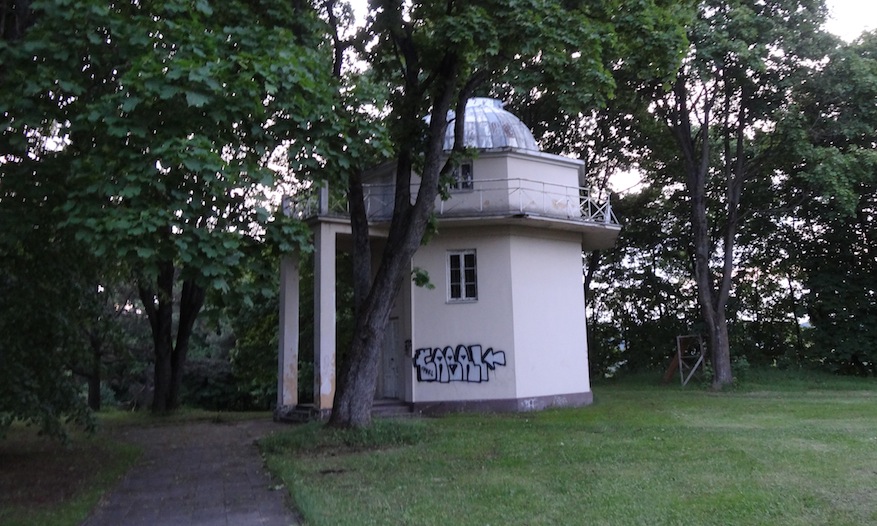
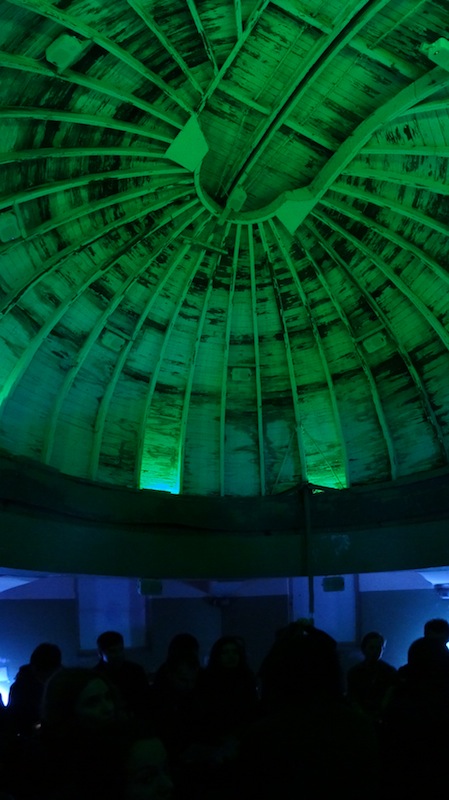
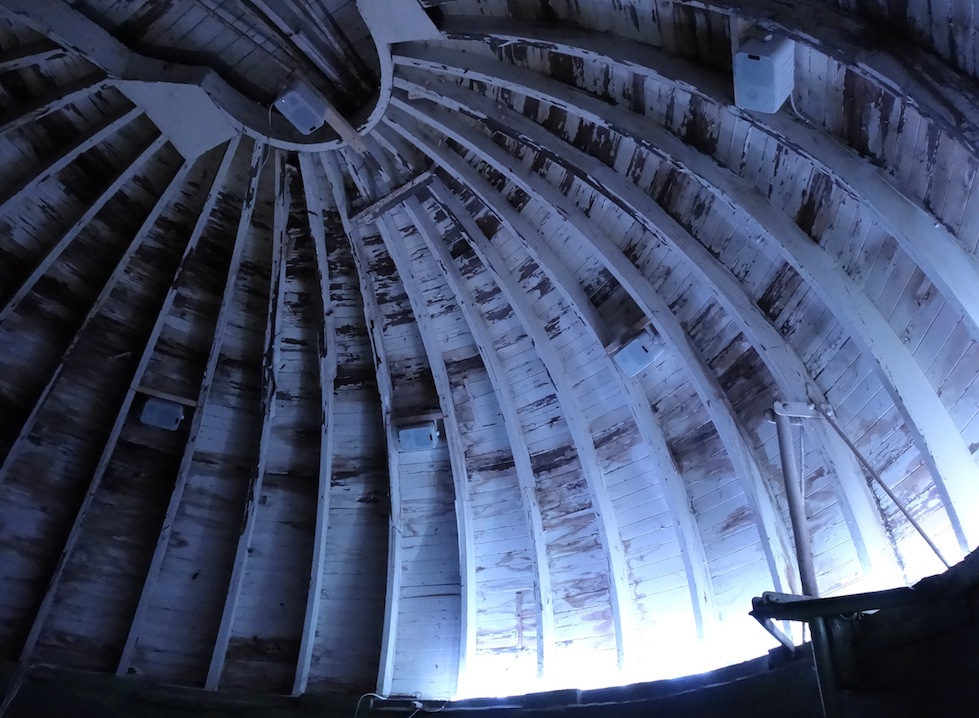
observatory domeAs part of the ahead festival, the first public concerts will be held in the loudspeaker sphere of the VU observatory. Due to the limited space there will be three performances and registration for each date/time will be limited.
Entrance is free.

dates:
Thursday, November 21st – 19:00
Friday, November 22nd – 17:00, 19:00 and 21:00
additional date: Tuesday, December 3rd – 17:00 and 19:00

entrance free but please register: http://doodle.com/wsgbze2chat8gfcg

observatory outsidelocation:
Astronomical Observatory of the Vilnius University
M.K.Čiurlionio g. 29 (the last building in direction of Vingio parkas)
Map: http://goo.gl/maps/4wKD1

concert program:

Helene Hedsund (SE) – Miškas (2012)

ahead logoLukrecija Petkute (LT) – Dvi burnos (2013)
Aistė Vaitkevičiūtė (LT) – Spheral Motions (2013)
Jurgis Jarašius (LT) – Martlet (2013)
Julius Aglinskas (LT) – Within (2013)
Matthias Kronlachner (AT) – Table top (2013)
Domas Ruškys (LT) – In my circle (2013)
Ignas Juzokas (LT) – Gabalai (2013)
Gerriet K. Sharma (DE) – I_LAND (excerpt) (2007-2009)

Download the concert flyer as .pdf

This concert would not be possible without the substantial support of some people:

Vladas Vansevičius from the Astronomical Observatory of Vilnius University for providing the facilities!
Jurgis Jarašius for his help in setting up the loudspeaker system and cleaning up the observatory!
The Music Innovation Studies Centre of LMTA – Tadas Dailyda, Ričardas Kabelis and Mantautas Krukauskas.
Ignas Juzokas for lending various equipment!
The Institute of Electronic Music and Acoustic for their AllRad Ambisonics decoders.
Continue reading →

mcfx v0.6.0 – multichannel audio plug-in suite

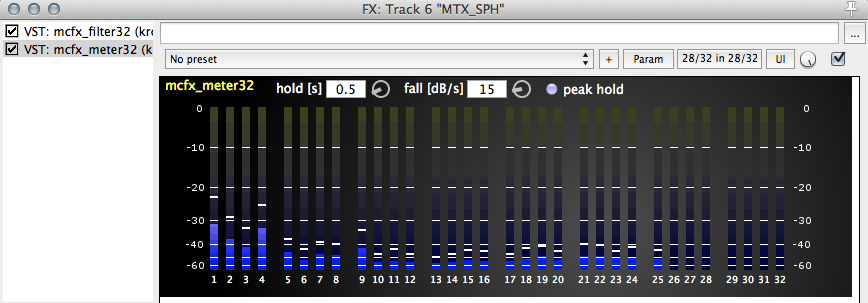
mcfx_meter32mcfx is a suite of multichannel VST plug-ins for MacOS, Windows and Linux
(mcfx_convolver, mcfx_delay, mcfx_filter, mcfx_gain_delay, mcfx_meter)

these plug-ins are very handy if you want to process multiple channels in one go for example
* multiple loudspeaker setups, Ambisonics (see ambiX)
* Microphone array post productions (eg. Eigenmike®)
….mcfx_filter_screenshot

currently high channel counts per track are only possible with the DAWs Reaper (Win, OSX) and Ardour (Linux, OSX)

– channel count is configurable with compile time flag
– cross plattform VST for MacOSX, Windows and Linux
– uses the JUCE framework (www.juce.com)
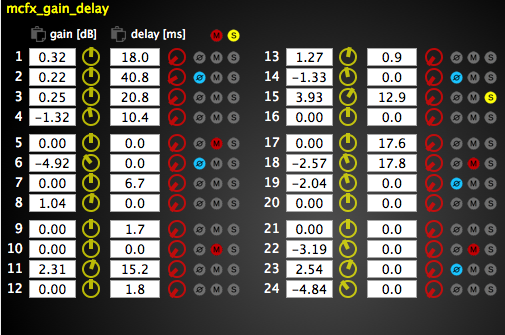
– ready to use binaries for MacOSX (≥ 10.7, 32/64 bit, Apple Silicon) and Windows (32/64 bit)mcfx_gain_delay_screenshot

Source code: https://github.com/kronihias/mcfx

VST Binaries: (2, 4, 8, 16, 24, 32, 36, 50, 64 channel version)


DOWNLOAD:

downloadDownload binaries from: https://github.com/kronihias/mcfx/releases


Additionally you can download some example first order B-format reverb presets for mcfx_convolver: mcfx_convolver_presets_v0.1.zip
Here is a help file explaining the .conf files.
Note that you have to use ambix_converter after the convolver and choose the preset .amb -> ambix in case you want to use those impulse responses in combination with ambix_decoder or ambix_binaural.

Continue reading →

Headtracking for Binaural Ambisonic Playback

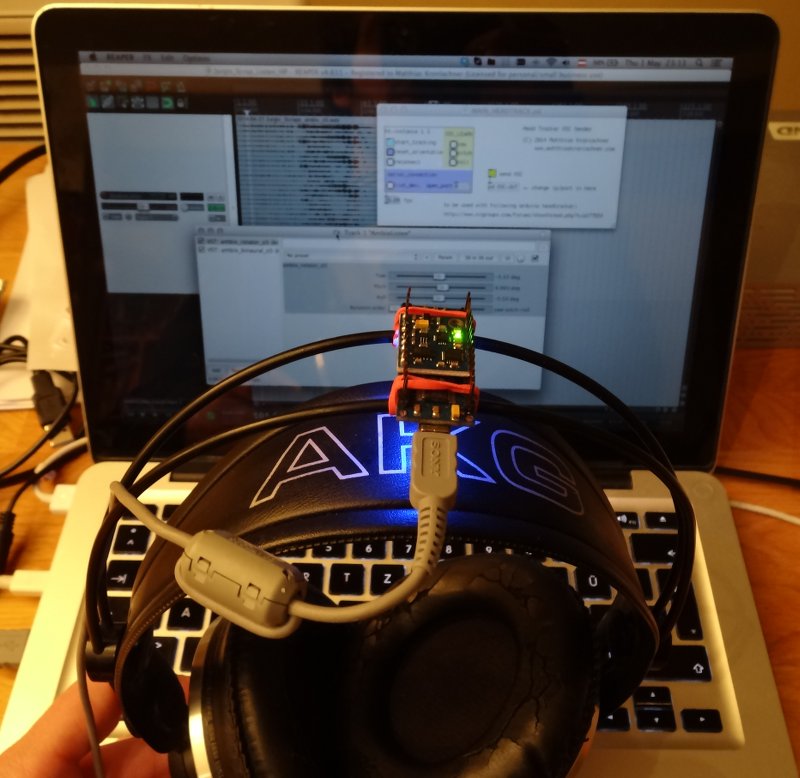
Low-Budget headtracker mounted on headphonesHere is a short tutorial about an inexpensive headtracking solution which you can use to improve the binaural listening experience with the ambix Ambisonic tools. The calibration software is currently Windows only, but the Pd patch is naturally cross-platform.

It uses the headtracker described here by Dennis Frie: http://www.rcgroups.com/forums/showthread.php?t=1677559
Parts: arduino nano, GY-85 sensor board.

A Pure Data patch provided by me receives the serial data from the Arduino based headtracker and sends OSC messages to the host of your choice. In this case I will describe the use within the digital audio workstation Reaper.

downloadFor the impatient, here is the Pure Data patch (use with Pd-extended):
pd-patch-headtracker-osc-sender


1)
First you have to get the Arduino and Sensor Board, some soldering and upload the firmware according to the instructions here.

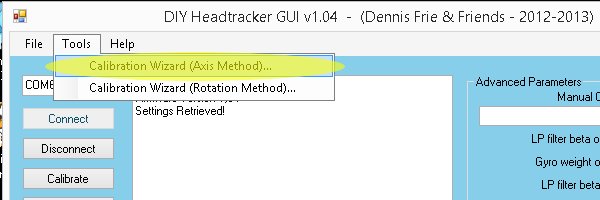
Use the Axis Method for calibrationUse the provided Windows software to calibrate the tracker – for me the Axis Method works best. You might have to repeat the calibration from time to time.

2) Now you can use the Pd Patch I provide to communicate with the tracker. Use Pd-Extended to open it!
Download: pd-patch-headtracker-osc-sender
This patch will translate the serial data from the Arduino board to OSC messages.

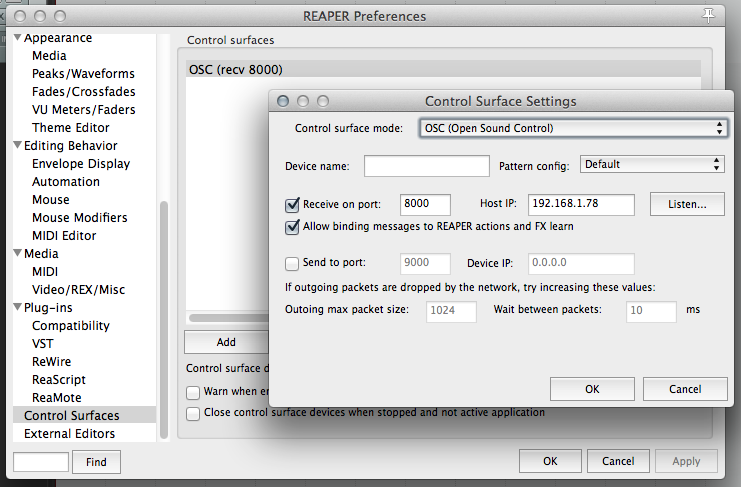
reaper_control_surfaces3) Open up the Reaper preferences and add an OSC control surface. Important: Receive on port 8000 and Allow binding messages to REAPER actions and FX learn.

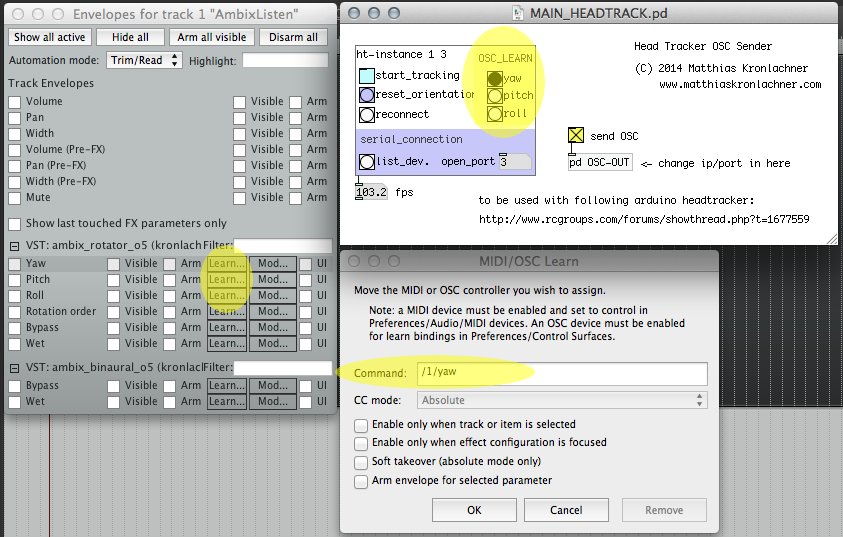
4) Add the ambix_rotator plug-in before ambix_binaural and use the OSC tracking data to control the parameters of ambix_rotator:
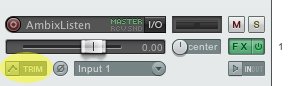
Click the Track Envelopes/Automation Button of thReaper Track Envelopes/Automatione Track with ambix_rotator to open up the Automation controls. Now click the Learn… Button next to the parameter Yaw.

Now you have to send a OSC message from the Pd patch to attach the correct message to Yaw, Pitch and Roll. Therefore don’t activate tracking yet (as it sends out all three messages Reaper OSC learn and Pd patchat once and thus does not allow to use the Learn functionality)
Instead click the buttons below OSC_LEARN in the Pd-patch to trigger single OSC messages.

5) You may have to change the serial port in Pd. First click the button list_dev to get a list of you serial devices. Enter the serial port id in the number box open_port.
Now you can activate head tracking and enjoy a stable binaural surround image. Use reset_orientation to define your zero degree direction.

table top – binaural recording

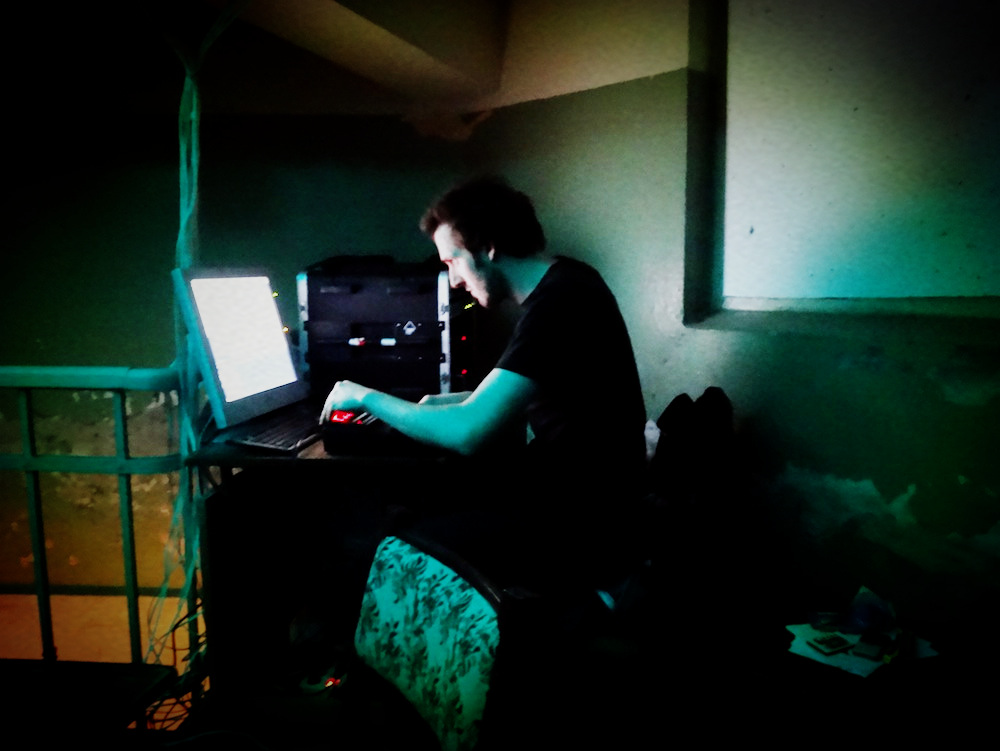
playing table top in the observatorytable top is a live performance by Matthias Kronlachner created for the loudspeaker sphere in the Astronomical Observatory tower of Vilnius University.
The performance was recorded on November 22nd, 2013 and December 3rd, 2013.

The original format of the piece is 5th order 3D Ambisonics, but you can listen to a binaural mixdown here: (please listen with high quality headphones!)

table-top-4 (November 22nd, 2013)

table-top-6 (December 3rd, 2013)

observatory concertThe binaural mixdown was done with the ambix Ambisonics Plug-Ins and the 24 binaural loudspeaker impulse responses are taken from the IEM Cube. Therefore you are virtually placed in the IEM Cube during listening to this piece with headphones.
Continue reading →