
ambiX – Ambisonic plug-in suite
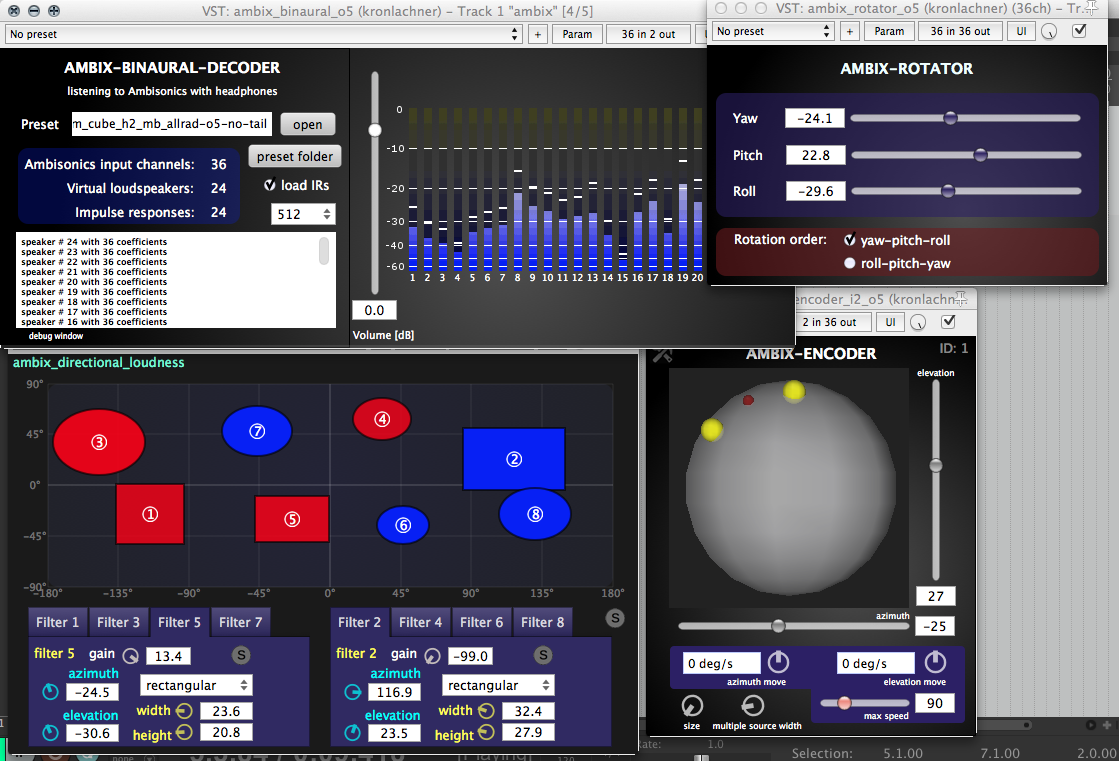 ambiX is a suite of free, cross-platform Ambisonic plug-ins for producing and post-producing 3D audio – encoding, rotating, warping, widening, decoding to loudspeakers or to headphones. They work in any multichannel host such as REAPER, Ardour or Max, and as standalone applications.
I first released them in January 2014, developed during my master thesis at the Institute of Electronic Music and Acoustics in Graz. Together with mcfx they won the gold award at the AES Student Design Competition 2014, were promoted by Google for YouTube Ambisonics productions, and are still in wide use. The plug-ins follow the ambiX convention: full 3D, ACN channel order, SN3D normalization.
Download: github.com/kronihias/ambix/releases – installers for macOS and Windows; on Linux they can be built from source. Source code: github.com/kronihias/ambix (GPL).
What’s new
In 2026 the suite got a major overhaul (versions 0.4 and 0.5):
- VST3: a single plug-in per tool that adapts to the Ambisonic order of the track – no more separate versions for each order. VST2 and LV2 builds for fixed orders remain for older hosts.
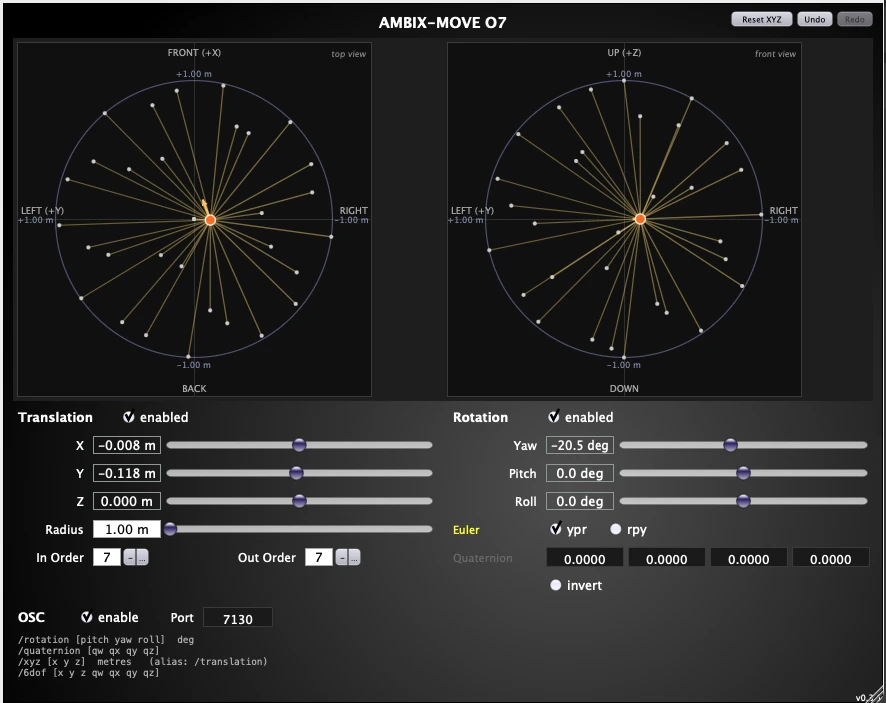
- ambix_move – new: moves the listener position (x/y/z) and rotates the sound field, with OSC control for 6DoF head tracking in binaural playback.
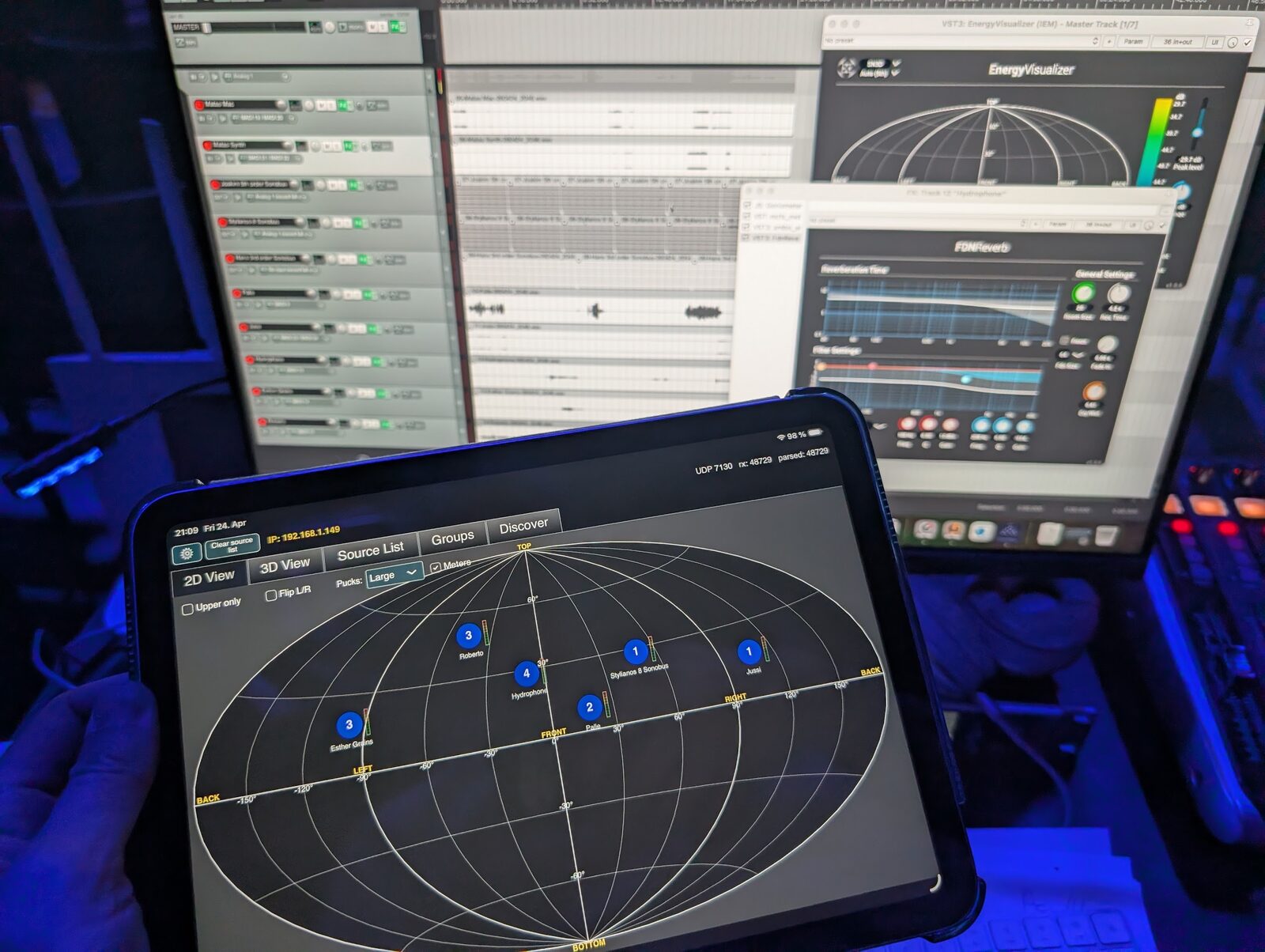
- ambix_visualizer – new standalone app for macOS and iPad: shows the positions of all
ambix_encoderinstances (and IEM MultiEncoder) on a sphere or Hammer-Aitoff map in real time. Encoders on the local network are found automatically. - ambix_encoder rebuilt: one instance handles many sources, linked or unlinked, with a pop-out panning view, solo/mute per source and presets compatible with the IEM MultiEncoder and SPARTA.
- New graphical editors for ambix_widening and ambix_warp; ambix_directional_loudness shows the energy distribution before and after the modification.
- JUCE 8, a JACK standalone for Linux, and every plug-in tested automatically on macOS, Windows and Linux (native Apple Silicon builds exist since version 0.3 in 2022).
The plug-ins
- ambix_encoder – panning of one or many sources, with OSC remote control
- ambix_binaural – binaural decoder with impulse responses of real loudspeaker setups and venues
- ambix_decoder – the same without convolution, for loudspeakers (for new setups the IEM AllRADecoder is easier to work with)
- ambix_converter – converts between Ambisonic conventions on the fly, including FuMa ↔ ambiX and 2D ↔ 3D
- ambix_rotator, ambix_rotator_z – rotation, also via OSC (Euler angles or quaternions) for head tracking
- ambix_move – translation and rotation of the listener position
- ambix_mirror – mirrors or inverts the sound field about the x, y or z axis
- ambix_warp – warps the sound field towards the equator, the poles, front or back
- ambix_widening – frequency-dependent rotation for source widening or diffuse early reflections (with Franz Zotter and Matthias Frank, article)
- ambix_directional_loudness – amplifies, attenuates or filters regions of the sound field
- ambix_vmic – virtual microphones: outputs selected regions of the sound field as audio
- ambix_maxre – applies (or removes) max-rE weighting
- ambix_visualizer – standalone source display (see above)
Files in the ambiX format can be read and written in REAPER with reaper_ambix, and multichannel processing such as convolution, EQ and metering is covered by mcfx.
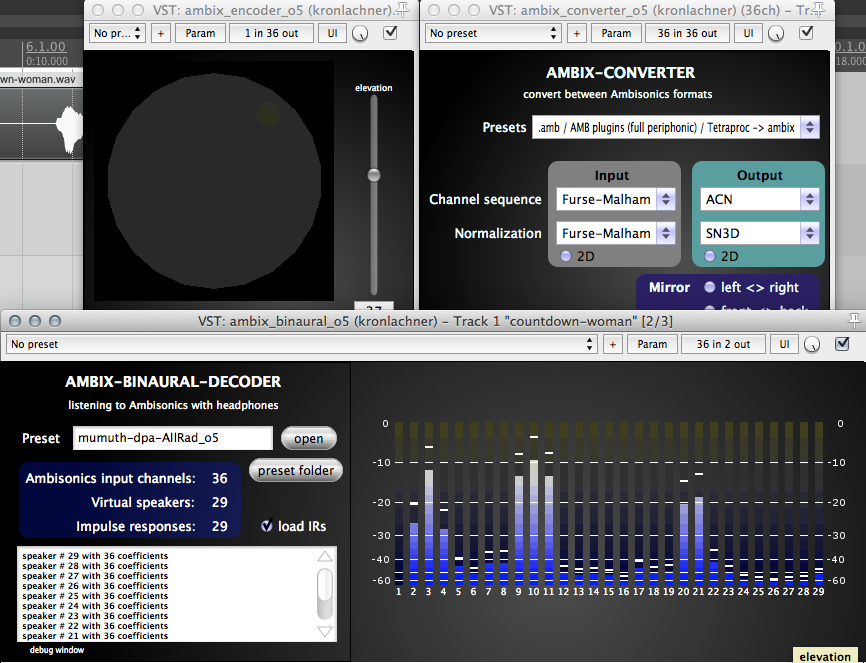 A short video of the original plug-ins in action (2013): https://vimeo.com/81073470
Binaural presets
For listening with headphones, ambix_binaural needs decoder presets: ambix_binaural_presets_v0.1.5.zip (decoder matrices and binaural loudspeaker impulse responses). More good presets from the BBC: https://github.com/bbc/bbcrd-brirs
Install them to:
- Windows:
C:\Users\<username>\AppData\Roaming\ambix\binaural_presets\ - macOS:
~/Library/ambix/binaural_presets/ - Linux:
~/ambix/binaural_presets/
Decoder matrices for other setups can be generated, for example, with the Ambisonic Decoder Toolbox by Aaron Heller (LAC article).
Background reading
- AES Student Design Competition 2014 – article about the plug-ins
- Ambisonics plug-in suite for production and performance usage, LAC 2013
- Spatial transformations for the enhancement of Ambisonic recordings, ICSA 2014
- Spatial Transformations for the Alteration of Ambisonic Recordings, master thesis 2014
Build instructions, OSC reference and the full changelog are in the README on GitHub.
Thanks
Several people and institutions contributed to this software in one way or another: Institute of Electronic Music and Acoustics Graz, Franz Zotter, Winfried Ritsch, Martin Rumori, Florian Hollerweger, Peter Plessas, IOhannes Zmölnig, Thomas Musil, Gerriet K. Sharma, Matthias Frank, Fons Adriaensen, Jörn Nettingsmeier, Filipe Coelho (DISTRHO project), Music Innovation Studies Centre of the Lithuanian Academy of Music and Theatre, Ričardas Kabelis, Mantautas Krukauskas, Tadas Dailyda, Sebastian Grill, and the surround sound and Linux audio community.